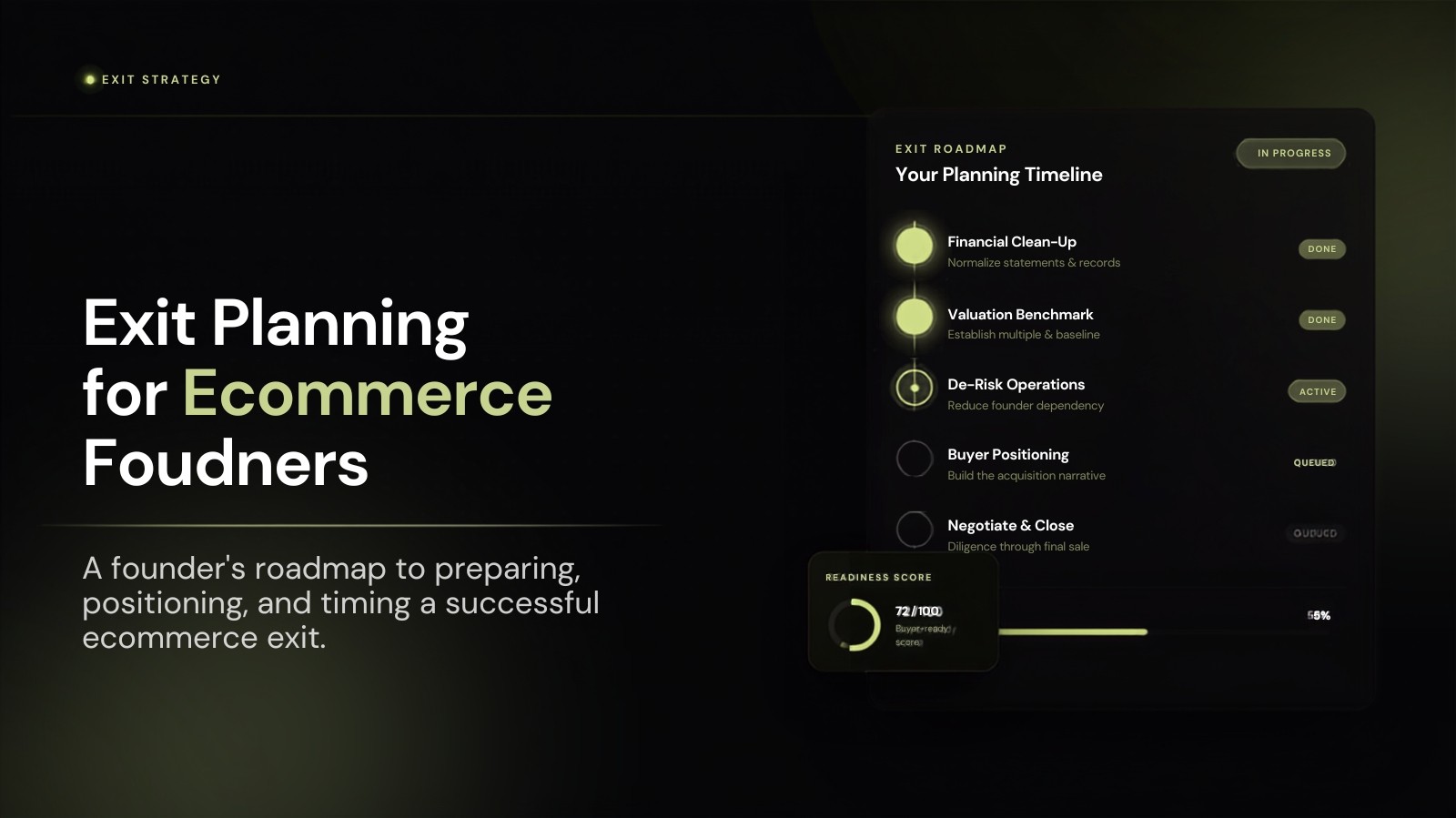
Exit Planning for Ecommerce Founders: The Blueprint for Maximizing Enterprise Value
The journey of an ecommerce founder is rarely a straight line. It is a grueling, rewarding marathon characterized by late-night inventory crises, high-stakes PPC bidding, and the constant balancing act of scaling operations while maintaining brand integrity. Most founders spend 99% of their energy on growth—the art of getting products into customers' hands and winning the battle for market share.
However, there is a critical distinction between building a business that generates revenue and building an asset that generates long-term wealth.
At ExitEcom, we have observed that every ecommerce founder eventually faces a choice: to hold, to pivot, or to exit. The difference between an exit that secures your financial future and one that leaves money on the table is proactive exit planning. Exit planning isn't just a "sale strategy"—it is an operational philosophy that forces you to build a more efficient, profitable, and defensible business today.
Why Exit Planning is Not Just About Selling
Many founders view an exit as an event that happens at the end of the road. This perspective is dangerous. When you wait until you are "ready" to sell, you are often forced to take whatever the market offers, leaving you vulnerable to poor timing, buyer leverage, or lack of preparation.
By shifting your mindset to Exit Readiness now, you achieve three strategic advantages:
1. Increased Valuation Multiples
Buyers whether they are strategic acquirers, private equity firms, or aggregators, pay a premium for "turnkey" businesses. They are buying the future performance of your company, not just its history. When your operations are systemized, your financials are pristine, and your growth is predictable, you move from being a "risky startup" to a "stable, scalable asset." A business that runs itself will always command a higher multiple than a business that requires the founder's constant attention.
2. Emotional Freedom and Optionality
The most stressful exits are those born of burnout. When your business is primed for an exit, you have the option to step away on your terms. You aren't selling because you’re exhausted or because the business is failing; you are selling because you’ve achieved your objective. This puts you in the driver’s seat during negotiations and allows you to walk away with confidence.
3. Operational Excellence
The act of preparing for an exit exposes your inefficiencies. Whether it’s bloated inventory costs, an over-reliance on a single marketing channel, or a lack of documentation, the due diligence preparation process acts as a mirror. It shows you exactly where your business needs to improve to reach its next level of profitability. Ironically, the steps you take to prepare for an exit often increase your daily cash flow immediately.
The 5 Pillars of a High-Value Ecommerce Exit
To command a premium valuation, you must satisfy the rigorous criteria used by sophisticated investors. At ExitEcom, we focus on the five pillars that dictate your final exit multiple.
Pillar 1: Financial Hygiene and "Clean" Books
In the world of M&A, your P&L is your resume. If your books are disorganized, potential buyers will assume there are hidden skeletons in your closet, and they will adjust their offer downward to mitigate that perceived risk.
Normalization: Buyers want to see your "True Profit." This means normalizing your financials by removing owner-centric expenses—such as personal vehicles, non-business travel, or luxury perks—that don’t reflect the true cost of running the business.
The Audit Trail: Ensure that every expense is categorized, COGS are clearly defined, and your revenue streams are verified. If a buyer cannot understand how you make money within ten minutes of looking at your report, they will either walk away or lower their offer to compensate for the "complexity risk."
Pillar 2: Reducing Founder Dependency
The "Founder Trap" is the most common reason for valuation discounts. If you are the person who answers every customer support ticket, negotiates every shipping contract, and manages every ad spend, you haven't built a business—you’ve built a job.
Systemization: To maximize value, you must replace yourself. This is achieved through robust, living Standard Operating Procedures (SOPs). Whether you are using Notion, ClickUp, or internal wikis, every recurring process must be documented and repeatable by someone other than you.
The "Bus Factor": If you were hit by a bus tomorrow, would the business continue to operate? If the answer is "no," you have significant work to do before you can expect a premium exit price.
Pillar 3: Sustainable Profit Margins and Market Defensibility
Ecommerce is a low-barrier-to-entry market, which means competition is constant. To protect your valuation, you need to prove that your business has a "moat."
Brand Equity: Are you selling a commodity, or are you selling a brand? High customer loyalty, a strong email list, and a high Repeat Purchase Rate (RPR) are your best defenses against low-cost competitors.
Pricing Power: If you have the ability to raise prices without a significant drop in volume, you have a defensible business. Buyers look for this power as a sign of high product-market fit and strong brand equity.
Pillar 4: Supply Chain and Inventory Resilience
A business is only as strong as its ability to fulfill orders. Global logistics are volatile, and buyers are acutely aware of this risk.
Diversification: If your entire product line relies on a single factory in one region, you represent a massive risk. We encourage founders to diversify their sourcing and maintain strong relationships with multiple suppliers.
Inventory Management: Efficient turnover and proactive planning ensure that your cash isn't tied up in dead stock. Buyers love a healthy, fast-moving inventory cycle. It proves you understand how to manage working capital.
Pillar 5: Data-Driven Growth
A buyer is purchasing your future cash flow. You must be able to demonstrate, with data, that the growth you’ve achieved is repeatable.
Metrics That Matter: You need a deep understanding of your Customer Acquisition Cost (CAC), Lifetime Value (LTV), and ROAS. Showing that you can scale spend while maintaining profitability is the ultimate "green flag" for an acquirer. If you can show that for every dollar spent on marketing, you generate four dollars in revenue, you have a scalable machine that a buyer can confidently invest in.
The Strategic Timeline: When to Start?
The best time to start planning your exit was yesterday. The second best time is today.
Ideally, you should begin the planning process 36 months before your target exit date. This timeframe allows you to:
Refine your marketing mix: Reduce dependency on volatile ad platforms like Facebook or Google.
Optimize your tax structure: Ensure you work with CPAs who specialize in M&A to maximize your net proceeds (after-tax).
Demonstrate consistency: Prove year-over-year growth in both revenue and profit. Buyers want to see a trend line, not a spike.
Even if you are only 12 months away from a potential sale, a "Sprint to Exit" approach can help you tidy up your operations, consolidate your data, and present your business in the most favorable light.
Why Choose ExitEcom?
At ExitEcom, we don’t just offer generic business advice. We act as your strategic partner in preparing your brand for the most significant transaction of your career. We understand that your business is your life's work, and we treat it with the respect it deserves.
We provide a comprehensive suite of services designed for the modern ecommerce founder:
Valuation Benchmarking: We provide an objective, market-backed valuation so you know exactly where you stand compared to your competitors.
Operational Optimization: We help you identify the "leaks" in your business and plug them, improving your bottom line now—even if you decide to keep the business longer than planned.
Strategic Positioning: We help you craft the "Growth Story" that buyers want to hear. We ensure your documentation, narrative, and performance metrics align to create a compelling, low-risk investment opportunity.
Overcoming Common Exit Hurdles
Many founders fear the exit process because it seems overwhelming. They worry about the legal complexities, the tax implications, and the emotional toll of "letting go."
Our philosophy at ExitEcom is that you shouldn't have to face this alone. By breaking the exit process into manageable stages—Financial Readiness, Operational Readiness, Legal Readiness, and Market Readiness—we remove the guesswork. We turn a complex, intimidating financial transaction into a structured project with clear milestones and measurable outcomes.
Furthermore, we focus heavily on the human side of the exit. What are your goals after the sale? Are you looking for a clean break, or do you want to stay on as a consultant? Understanding your personal "why" is just as important as optimizing your SDE (Seller’s Discretionary Earnings).
Conclusion: Take Control of Your Legacy
Your ecommerce business is more than just a series of transactions; it’s a reflection of your vision and dedication. Whether your goal is to exit for a nine-figure sum or to sell your business to fund your next big idea, you owe it to yourself to be prepared.
Don’t leave your future to chance. Don’t wait for an unsolicited, low-ball offer from an aggregator to start thinking about what your business is worth. Take the proactive step toward clarity, value maximization, and peace of mind.
Are you ready to see what your business is truly worth?