The Business We Took On
Northgate Home Goods was a young, profitable e-commerce business in the home storage and décor space. Built on Shopify, it had real product demand behind it, especially its hero product, a storage ottoman set that customers clearly loved.
On paper, it looked like a solid acquisition target. Around £410,000 in annual revenue, consistently profitable, in a category with steady demand. But once we assessed it the way a buyer actually would, a different picture emerged.
Customers wanting the product was never the issue. The real question was whether a buyer could take this business over and run it confidently without the founder. At the time, the honest answer was no.
The founder was involved in nearly every part of the business. Financial reporting wasn't solid enough for a buyer to verify real profitability. 94% of traffic came from one paid channel, there was almost no retention infrastructure, and 85% of revenue came from a single product sourced from one overseas supplier.
Northgate didn't have a growth problem. It had an exit-readiness problem, and that's a different thing to solve.
What We Found
Founder dependency was the biggest issue. The founder managed the sole supplier relationship, ran and created all the ad campaigns, handled every customer escalation, and made every purchasing and cash flow decision personally. There was no system or team member who could step into any of that. A buyer isn't looking to acquire a job, they're looking to acquire an asset that keeps running without the person who built it. This alone cost the business an estimated 11 points on its Exit Readiness Score and roughly 0.6x on its EBITDA multiple.
94% of traffic came from one channel. Meta was working, but CAC had risen 52% over six months, and there was no SEO, no organic traffic, no meaningful email list, nothing to fall back on if that one channel had a bad month. Buyers don't read that as a marketing gap. They read it as a business continuity risk. Impact: –9 points, roughly –0.5x on the multiple.
The financials weren't buyer-ready. The business was profitable, but profitable and verifiable aren't the same thing. Bookkeeping was cash-basis, COGS were estimated rather than tracked, there was no per-SKU profitability, and business and personal finances weren't cleanly separated. A buyer can't pay a premium for earnings they can't verify. Impact: –7 points, roughly –0.35x on the multiple.
One product, one supplier, no backup. The storage ottoman set accounted for 85% of revenue, sourced entirely from one overseas manufacturer with no secondary supplier in place, and the business had already had two stockouts in the past year. That's concentration risk on two fronts at once, product and supply chain, and buyers tend to treat that as a binary risk rather than a minor one. Impact: –6 points, roughly –0.3x on the multiple.
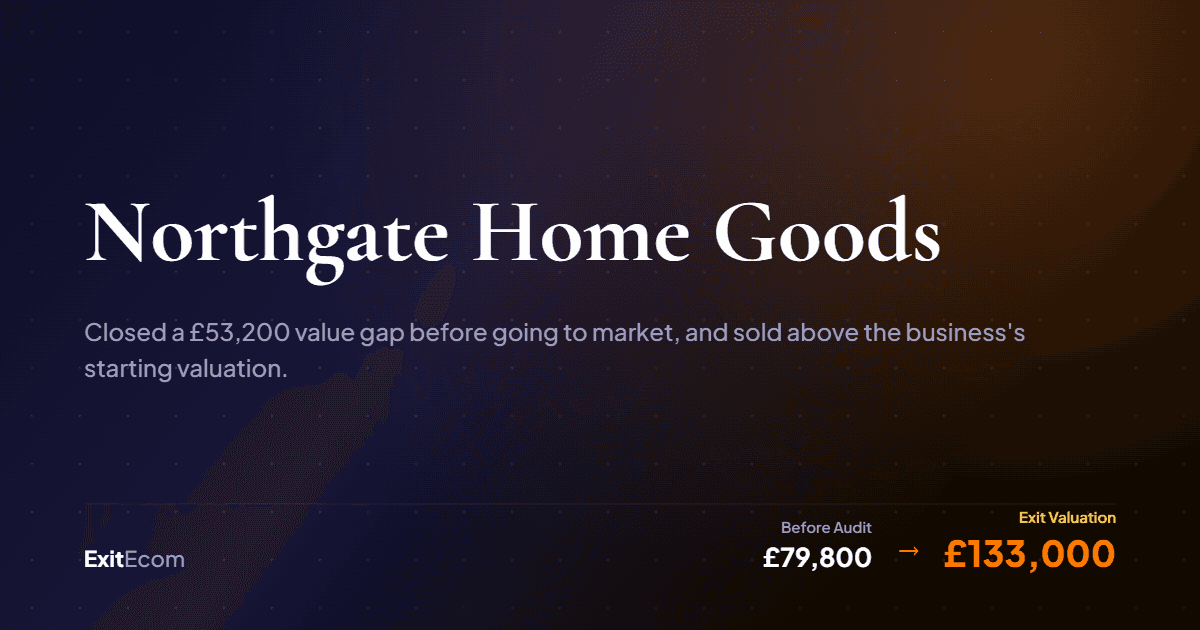
Altogether, these four issues were suppressing the business by an estimated 1.75x EBITDA, the gap between a business worth roughly £79,800 and one worth closer to £133,000.
What We Did
Rather than just telling Northgate what the business was worth, we worked with them to close the gap between that number and what it could be.
We built real financial controls. Separated business and personal finances, moved toward accrual-based bookkeeping, tracked COGS properly, and rebuilt a clean trailing twelve-month P&L with per-SKU profitability. The goal was simple: remove the guesswork from any future valuation conversation.
We reduced founder dependency. Documented the supplier relationship and transitioned it to operational support, wrote purchasing processes and ad briefs, set up a shared customer service inbox, and brought in support for order management. Not to remove the founder overnight, but to prove the business could function without him doing everything personally.
We diversified how the business acquired customers. Built email capture and retention flows, tested Google Shopping and TikTok alongside Meta, and started basic SEO work around high-intent keywords. The point wasn't to drop Meta, it was to make sure Meta wasn't the only thing standing between the business and its customers.
We reduced product and supplier concentration. Qualified a secondary supplier, documented the relationship, built a minimum inventory buffer, and launched a second product to start pulling revenue away from total reliance on the hero SKU.
The Result
Over the following months, Northgate's Exit Readiness Score moved from 34 to 78. Exit probability climbed from 29% to well above where it started. The business's estimated value moved from £79,800 toward the £133,000 potential we'd identified at the outset, and when it went to market, it sold for £107,000, closing the majority of the £53,200 value gap we'd flagged in the original assessment.
That's the difference between a business that was merely profitable and one that was actually ready to be sold.
What This Confirmed
Being profitable isn't the same as being exit-ready. Northgate was already making money, and it still came back as an "at risk" business on its first assessment. Buyers aren't just paying for today's profit, they're paying for confidence that the profit continues after they take over.
Founder dependency is a valuation problem, not just an operational one. Founders often see their own involvement as a strength. Buyers usually see it as risk sitting in one place. The more the business depends on one person, the harder it is for anyone else to confidently take it on.
Concentration quietly suppresses price. One channel, one product, one supplier, each one compounds the others. Spreading revenue across more sources doesn't just support growth, it makes that revenue more durable, and durable revenue is worth more to a buyer.
Clean financials can unlock value without a single extra sale. Northgate didn't need more revenue for its financial picture to become more valuable. Making the numbers accurate, documented, and verifiable removed one of the biggest obstacles standing between the business and a serious offer.
Conclusion
Northgate Home Goods had everything a buyer should want to see: proven demand, real profit, room to grow. What was holding it back wasn't the business itself, it was how dependent, concentrated, and unverifiable it looked from the outside.
The £53,200 value gap was never just a number on a report. It was the actual difference between the business the founder had built and the business a buyer was willing to pay for. Closing it wasn't about making Northgate bigger. It was about making it transferable, verifiable, and a lot less risky to own.
That's the work. We don't just tell founders what their business is worth today. We find what's holding that number back, put a figure on it, and close the gap before a buyer ever sees it.